310 West 14th North Street, NY
(+1) 88 700 600




ISO 9001 is defined as the international standard that specifies requirements for a quality management system (QMS). Organizations use the standard to demonstrate the ability to consistently provide products and services that meet customer and regulatory requirements.
The International Organization for Standardization (ISO) is a non-governmental organization whose role is to facilitate international coordination and the standardization of industrial standards. These standards contribute to the development, manufacturing and delivery of products and services that are more effective, safer and clearer. ISO performs systematic reviews every 3-5 years to keep these standards up-to-date.
The revision process adjusts them to changes in the environment with the aim at improving organization’s ability to offer products and services that meet customer’s requirements. ISO has revised world’s leading Quality Management System (QMS), ISO 9001:2008 to ISO 9001:2015.
Quality management system is defined as a set of interrelated or interacting ele- ments to establish policies, objectives, and processes to achieve those objec- tives with regard to quality.
QMS is part of the overall management system, based on a business risk ap- proach, to establish, implement, operate, monitor, review, maintain and improve quality.
ISO 9001:2015 specifies requirements to plan, establish, implement, operate, monitor, review, maintain and continually improve a documented management system used to manage quality. The requirements set in ISO 9001:2015 are generic, flexible and useful to all types of organizations. Thus, this ISO Management System Standard can be aligned and integrated with other Management Systems such as Energy Management, Business Continuity Management and other management systems, due to their similar structure.
ISO 9001:2015 is the first quality management standard to be fully compliant with the new guidelines from Annex SL (“High level structure and identical text for management system standards and common core management system terms and definitions”). It has been developed in response to standards users’ critics that, while current standards have many common components, they are not sufficiently aligned, making it difficult for organizations to rationalize their systems and to interface and integrate them. This means that ISO 9001 is integrated to the high-level structure and common text that will make it totally aligned with all other management systems once the related standards have also adopted the Annex SL guidelines.
Following the new structure of the Annex SL, ISO 9001 is organized into the following main clauses:
Clause 1: Scope
Clause 2: Normative references
Clause 3: Terms and definitions
Clause 4: Context of the organization
Clause 5: Leadership
Clause 6: Planning for the quality management system
Clause 7: Support
Clause 8: Operation
Clause 9: Performance evaluation Clause
10: Improvement
Each of these key areas is listed and described below.
Clause 4: Context of the organization
The organization shall determine external and internal issues that are relevant to its purpose and its strategic direction and that affect its ability to achieve the intended result(s) of its QMS such as:
Defining the scope of the QMS, taking into account the organization’s strategic objectives, key products and services, risk tolerance, and any regulatory, contractual or stakeholder obligations is also part of this clause.
Clause 5: Leadership
Top management shall demonstrate leadership and commitment with respect to the quality management system by:
Clause 6: Planning for the quality management system
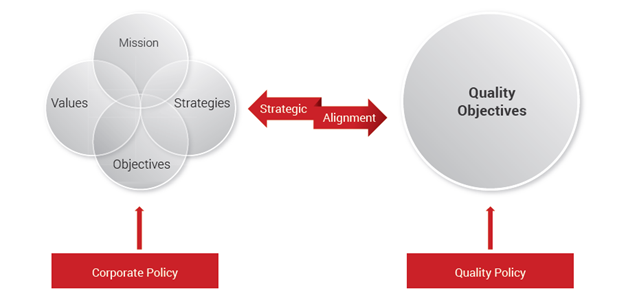
This is a critical stage as it relates to establishing strategic objectives and guiding principles for the QMS as a whole. The intent of the organization to treat the risks identified and/or to comply with the QMS requirements can be expressed through the QMS objectives. The quality objectives shall:
An organization wishing to comply with ISO 9001 shall at least:
Clause 7: Support
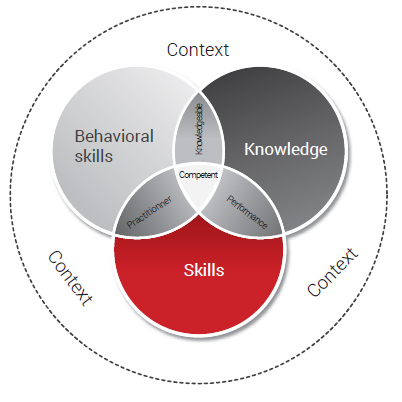
The day-to-day management of an effective quality management system relies heavily on using the appropriate resources for each task. These include having competent staff with relevant (and demonstrable) training and supporting services, awareness and communication. This must be supported by properly managed documented information.
Both internal and external communications of the organization must be considered in this area, including the format, the content and the proper timing of such communications.
The requirements on the creation, update and control of documented information are also specified in this clause.
Clause 8: Operation
After planning the QMS, an organization must put it into operation. This clause includes:
Operational planning and control: This activity includes implementation of plans and processes that lead the organization towards meeting the quality management system requirements. Additionally, this clause requires from organizations that they establish controls which help in preventing any deviation from the quality policy, objectives, and legal requirements.
After the requirements have been established, the organization should control the planned changes and review the unintended changes to mitigate any adverse effect. All the processes within the organization, including outsourced processes should be controlled.
Determination of requirements for products and services: The organization shall determine all the requirements related to products and services, such as customer requirements, organizational, statutory and regulatory, and ISO 9001:2015 requirements. The organization shall establish an effective customer communication process. After all the requirements have been determined, they must be reviewed to ensure contract or order requirements differing from those previously defined are resolved.
Design and development of products and services: This activity requires that organizations establish, implement and maintain a design and development process.
Control of externally provided products and services: The organization shall ensure that externally provided processes, procedures, and services conform to specified requirements. This clause applies to both physical products and consumed services related to the end product of the organization. An organization will need to apply a risk-based approach and determine the type and extent of controls necessary.
Production and service provision: Businesses should control delivery and post-delivery activities to ensure that the product and service provision is implemented under controlled conditions. This requirement expects from organizations to have traceability mechanism to identify process outputs, protect and safeguard the property belonging to customers or external providers, and to preserve the products and services.
Release of products and services: Organization should verify conformance to acceptance criteria when re-leasing the products and services. Acceptance criteria is the criteria set by the organization specifying certain indicators or measures employed in assessing the ability of a component, structure, or system to perform its intended function. Setting the criteria before initiating the project makes its development much easier. Each organization should define its own criteria in order to ensure a higher level of customer satisfaction.
Control of nonconforming process outputs, products and services: This activity involves identification of control of products and services to ensure that they comply with the stated requirements. Nonconforming processes, products and services have to be corrected, segregated, or returned. Additionally, the standard requires that organization inform the customers for the nonconforming products to prevent customer dissatisfaction.
Clause 9: Performance Evaluation
Once the QMS is implemented, ISO 9001 requires permanent monitoring of the system as well as periodic reviews to:
Clause 10: Improvement
Continual improvement can be defined as all the actions taken throughout the organization to increase effectiveness (reaching objectives) and efficiency (an optimal cost/benefit ratio) of processes and controls to bring increased benefits to the organization and its stakeholders. An organization can continually improve the effectiveness of its management system through the use of the quality policy, objectives, and audit results, analysis of monitored events, indicators, risk analysis, corrective actions and management review.
Risk based approach
By undertaking risk-based approach, any organization can become more proactive rather than only reactive to changes in the context in which it evolves. It can thus better prevent or reduce undesired effects and can then better promote continual improvement. Preventive action becomes rather ‘automatic’ when a management system is risk-based.
In this meaning, risk-based approach is one of the major changes in the new version of ISO 9001. The 9001:2015 has replaced the ‘preventive action’ concept with a set of requirements on managing risk. Some risk analysis was implicit in the old version of the standard through preventive action analysis, but the new version makes risk more explicit by incorporating it throughout the quality management system.
The risk-based approach came as a result of the incorporation of Annex SL into ISO 9001:2015. It plays an important part in the new version of the standard, and it has clear clauses to determine risks and take actions. Even though the concept of ‘risk’ is new in ISO 9001:2015, many organizations already have an approach in place to manage risk. They have to align it with ISO 9001:2015 requirements and show that the requirements are met.
Risk can be found in the following clauses of ISO 9001:
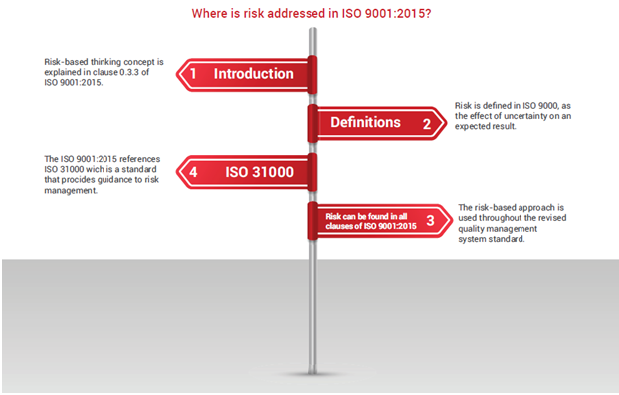
Various standards such as ISO 9004 and ISO 9000 are used to complement ISO 9001:2015. ISO 9004 provides guidance to organizations to support the achievement of sustained success by a quality management approach. ISO 9004 standard provides additional guidelines on customer focus, defect prevention, cost control, process approach, documentation, purchasing, informed decision-making, training and employee motivation. In addition, ISO 9000 discusses definitions and terminology and is used to clarify the concepts used by the ISO 9001 and ISO 9004 standards.
Other standards that are closely linked to ISO 9001:2015 are sector specific standards. These standards are meant to complement quality management system in defining best practice within certain sectors, and tackle the issues which ISO 9001 does not cover. Sector specific quality management standards include ISO 16949 (automotive industry), AS 9100 (aerospace industry), TL 9000 (telecommunications industry), ISO 13485 (medical devices), ISO 29001 (oil and gas industry), and so on.
Integration with other management systems
General requirements presented in the table below are commonly stated in any management system and relate to determining objectives, applying them according to the organization’s habits and needs, keeping them alive based on a strong management commitment, monitoring and reviewing, supporting the management system by good documentation, regular ‘health-checks’ via internal or external audits and to gain benefits through continual improvement as achieved by a regular management review.
The table below shows how a QMS can be considered jointly with other management systems. This will authorize the organization to envision “combined audits” in order to achieve their compliance goals with adequate effort and budget.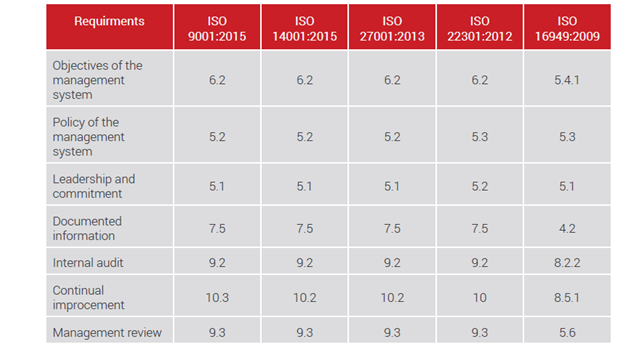
As with all major undertakings within an organization, it is essential to gain the support and sponsorship of executive management. By far, the best way to achieve this is to illustrate the positive gains of having an effective quality management process in place, rather than highlighting the negative aspects of the contrary.
Today, an effective quality management is not about being forced into taking action to address external pressures, but its importance relies on recognizing the positive value of quality good practice being embedded throughout your organization.
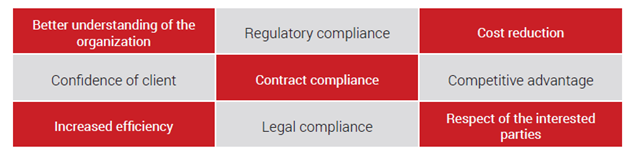
The adoption of an effective quality management process within an organization will have benefits in a number of areas, examples of which include:
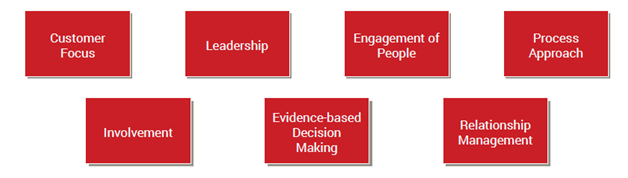
ISO 9001:2015 is based on seven quality management principles that can be used by top management to lead the organization towards improved performance.
Making the decision to implement a Quality Management System based on ISO 9001 may often be a simple one, as the benefits are well documented. It is important to follow a structured and effective methodology to cover all the minimum requirements for the implementation of a quality management system. Most companies now realize that it is not sufficient to implement a generic, “one size fits all” quality management program. For an effective implementation methodology, organizations need to take into account specific risks that would impact the quality performance. A more difficult task is the compilation of an implementation plan that balances the requirements of the standard, the business needs and the deadline to become certified.
There is no single blueprint for implementing ISO 9001 that will work for every company, but there are some common steps that will allow the organization to balance the often conflicting requirements and prepare for a successful certification audit. Whatever methodology used, the organization must adapt it to its particular context (requirements, size of the organization, scope, objectives, and so on).
Kwalitea Konsultants has developed a methodology for implementing a management system. It is called “Integrated Implementation Methodology for Management Systems and Standards (IMS2)” and is based on applicable best practices. This methodology is based on the guidelines of ISO standards and also meets the requirements of ISO 9001.
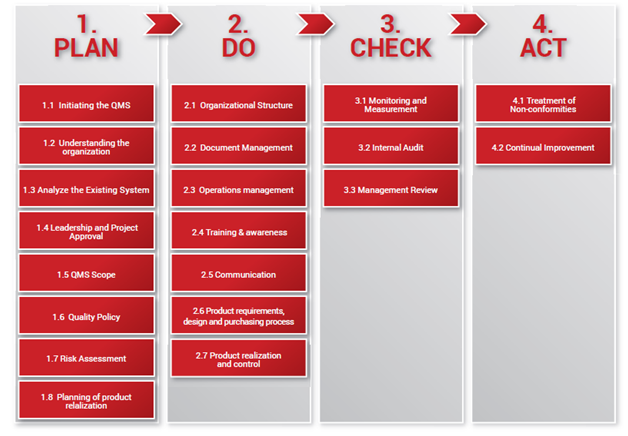
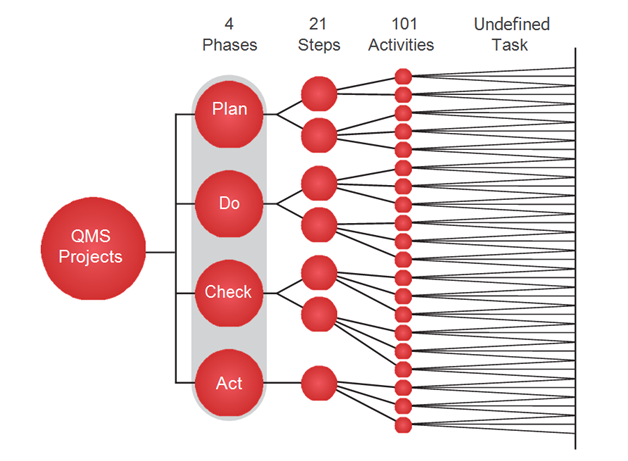
IMS2 is based on the PDCA cycle divided into four phases: Plan, Do, Check and Act. Each phase has be- tween 2 and 8 steps for a total of 20 steps. In turn, these steps are divided into 101 activities and tasks. This ‘Practical Guide’ considers the key phases in the implementation project from start to finish and suggests the appropriate ‘best practice’ for each one, while directing the organization to further helpful resources as it embarks on its ISO 9001 journey.
By following a structured and effective methodology, an organization can be sure it covers all minimum requirements for the implementation of a management system. As mentioned above, whatever methodology used, the organization must adapt it to its particular context, and not apply it like a cookbook. The key to implementation lies in a contextualized and adaptable approach by the organization, which will ensure a robust outcome.
The sequence of steps required in this process may be changed (inversion, merge), to meet the most suit- able outcome. For example, the implementation of the management procedure for documented information can be done before the understanding of the organization. Many processes are iterative because of the need for progressive development throughout the implementation project; for example, communication and training.
Certification of organizations
The usual path for an organization that wishes to be certified against ISO 9001 is the following:
4.Pre-assessment audit (optional): An organization can choose to perform a pre-audit to identify any possible gap between its current management system and the requirements of the standard.
8.Confirmation of registration: If the organization is compliant with the conditions of the standard, the Registrar confirms the registration and publishes the certificate.